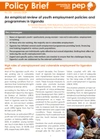
An Empirical Review of Youth Employment Policies in Uganda
Most Ugandan youths find themselves in vulnerable employment, grappling with inadequate earnings, low productivity, and poor working conditions that infringe upon their fundamental rights.
The Status of Youth Employment report by the Uganda Bureau of Statistics reveals that 43% of the youth in Uganda are self-employed as own-account workers, with the proportion for male youth (39%) higher than that for female youth (31%). Moreover, 39% of youth lack employment, education, or training. Disturbingly, young women are significantly more likely to be NEETs than young men, at 50.5% and 29%.
PEP is partnering with the Mastercard Foundation for a three-year initiative on “What Works for Youth Employment in Africa.” It aims to provide evidence that can drive policy reform to increase youth employment in ten African countries.
Read more about the Youth Employment Policies in Africa.
Help us to make our research better
Thank you for visiting the Mastercard Foundation research library! We’d love to hear about your experience.
Thanks for your feedback
Latest Research
View All-
Assistive Technology Landscape In Africa
Disability Inclusion -
Africa Youth Employment Outlook 2026
Education and Transitions Burkina Faso, Guinea-Bissau, Djibouti, Mozambique, Egypt, Benin, Ghana, Senegal, Zambia, Uganda, Côte d’Ivoire, Sierra Leone, Eritrea, Gambia, Eswatini , Ethiopia, Democratic Republic of Congo, Tanzania, Nigeria, Zimbabwe, South Sudan, South Africa, Cameroon, Niger, Morocco, Kenya, Malawi, WAEMU, Chad, Mali, Rwanda, Togo, Somalia -
Building the Agriinfluencer Network
Agriculture Kenya, Rwanda, Ghana, Senegal, Uganda, Nigeria -
Study on Africa as a Jurisdiction for Domiciliation of Investment Vehicles - Full Report
WAEMU, Kenya, Rwanda, Burkina Faso, Guinea-Bissau, Djibouti, Mozambique, Egypt, Benin, Ghana, Senegal, Zambia, Uganda, Côte d’Ivoire, Sierra Leone, Eritrea, Gambia, Eswatini , Democratic Republic of Congo, Tanzania, Nigeria, Zimbabwe, South Sudan, South Africa, Cameroon, Ethiopia, Niger, Morocco, Malawi, Chad, Syria, Mali, Togo, Somalia