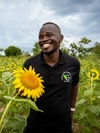
Jemila Abdulai
Engineering Dignity: How Jemila Abdulai Is Making Prosthetics More Accessible in Africa

A Mastercard Foundation Scholar’s journey from Ghana to Cape Town, designing 3D-printed prosthetics for underserved communities
By Jemila Abdulai (Master’s Degree in Biomedical Engineering)
Before landing in Cape Town, I had already travelled a long road, from earning a degree in Biomedical Engineering at Ghana’s Kwame Nkrumah University of Science and Technology to completing my National Service in the Records Department of the Volta River Authority Hospital in Accra. Growing up in a community with limited access to healthcare made the challenges of medical inequity deeply personal. That’s what drove me to engineering. I wanted to help close the gap between need and access.


Jemila Abdulai in Cape Town, South Africa
As a Mastercard Foundation Scholar at the University of Toronto, I interned at the University of Cape Town’s (UCT) MedTech Lab in May 2024 through the Africa Health Collaborative. What I found wasn’t just a lab – it was a launchpad for human-centred innovation and inclusive design. My primary focus was the Activity of Daily Living (ADL) Arm, a 3D-printed prosthetic designed for trans-radial amputees (amputation of the lower arm) in underserved communities. The project immediately resonated with me. It wasn’t just about building devices in isolation; it was about restoring dignity and independence. These prosthetic arms were engineered for real lives, not just clinical theory.
In a world where prosthetic limbs often cost thousands of dollars, the ADL Arm’s mission is simple but powerful: to make high-quality, affordable prosthetics accessible to those who need them most. Its primary objectives are creating intuitive designs that are easy to use, ensuring durability, and expanding access for communities everywhere. Ultimately, the project aspires to empower individuals with below-elbow amputation to regain independence and improve their quality of life, while advancing the field of affordable assistive technologies globally.
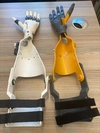
Activity of Daily Living (ADL) Arm prosthetics
My first weeks at UCT were a crash course in cutting-edge tech and purpose-driven design. I trained intensively in 3D printing, learned to troubleshoot mechanical issues, and studied prior iterations of the ADL Arm to identify areas for improvement. Later, I took part in assembling prototypes, writing technical documentation, and exploring the ethical and regulatory dimensions of deploying assistive devices in low-resource settings. These experiences equipped me with the knowledge necessary for the commercialization and clinical application of the ADL Arm.
Each day at the lab sharpened not only my technical skills but also my sense of purpose. I began to understand innovation not just as an invention, but as “empathy in action” – engineering that listens before it builds. Cape Town itself added another layer of depth. From its vibrant streets to the Heart of Cape Town Museum – home of the world’s first heart transplant – the city reminded me that medical breakthroughs have always come from bold ideas and brave people. I left inspired, not just by technology, but by the belief that it should serve the most vulnerable first.
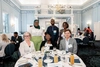

Jemila Abdulai with U of T staff and colleagues
I’m deeply grateful to the UCT MedTech team, led by Prof. Sudesh Sivarasu, Head of UCT MedTech and the Division of Biomedical Engineering, and Mr. Michael Awood, Chief Technology Officer for Disability and Assistive Technologies. I am also thankful to the University of Toronto team: Paul Yoo, Associate Director, Professional Programs, and Teresa Adderley, Industrial Program Manager and Internship Coordinator at the Institute of Biomedical Engineering. My appreciation extends to the Africa Health Collaborative, especially Dr. Angel Motsamai of the Secretariat, for making this invaluable experience possible.
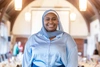
I came to Cape Town to learn, and I left more determined than ever to help humanize healthcare – one innovation at a time.
The Mastercard Foundation Scholarship program at the University of Toronto is implemented by the Center for International Experience, under the Africa Health Collaborative.
Listen to Jemila share her work on developing the ADL Arm on the Science to Society Podcast: iono.fm
The Journey So Far And What’s Next: Komlan Kekeli Batchey
Togo
Know What You Want and Go for It
Nigeria
Auto Spares Entrepreneurship in Nairobi
Kenya
From Kakuma Refugee Camp to the World Health Organization: Kuol Maper Alier’s Journey of Resilience and Global Health Innovation
South Sudan, Kenya
The Right To Belong: Apat’s Story
Costa Rica