Africa Higher Education For Transformation (AHEFT) Prize

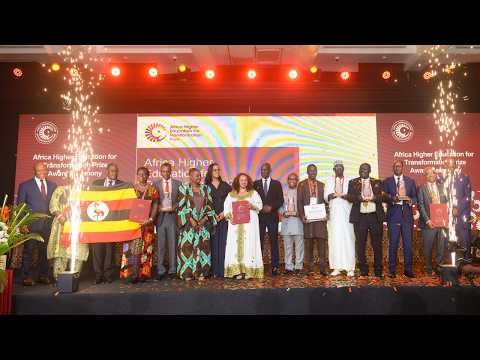
Watch the inaugural Africa Higher Education for Transformation Prize Recognition Ceremony honouring five exceptional institutions. Their bold leadership and innovation are expanding opportunities for young people and redefining what higher education can achieve.
Watch the 2026 AHEFT Prize Award Ceremony
About the AHEFT Prize
The AHEFT Prize recognizes institutions delivering transformational impact across thematic categories including Teaching and Learning, Transitions to Employment, Research and Innovation, and Entrepreneurship or within priority sectors such as Climate and Environment, Agriculture and Agri-food Systems, Health, and STEM/Digital/Artificial Intelligence. Over the next decade, the Prize will recognize and award at least 150 institutions across Africa.
About the Prize Inaugural Year
The inaugural cycle drew nominees from a shortlist of 25 higher education institutions within Mastercard Foundation’s existing partner network across Africa. This enabled the Foundation to establish the Prize and refine its approach ahead of future cohorts. Applications for future cycles will extend beyond the Foundation’s partner network to all higher education institutions in Africa.
Applications were assessed by an independent jury of distinguished educators, policymakers and sector experts against criteria spanning academic excellence, institutional transformation and real-world impact, relevance to Africa’s development priorities, inclusion and access, student experience, community engagement, and collaboration and partnerships, with strategic guidance from the Prize’s Advisory Group.
The AHEFT Prize recognizes institutions driving transformation across the following:


Since 2006, the Mastercard Foundation has grown its work in education and financial inclusion across Africa, from an early microfinance partnership reaching millions of people to the Mastercard Foundation Scholars Program, launched in 2012 to develop the next generation of transformative leaders, and the Young Africa Works strategy, launched in 2018 to enable 30 million young people to access dignified and fulfilling work by 2030. The AHEFT Prize extends that legacy, translating two decades of investment in African higher education into direct recognition and support for the institutions delivering the greatest impact, with the wider aim of accelerating innovation, investment, and ambition across the higher education ecosystem.
Higher Education Transformation Convening Media Release
Under the theme, “Reimagining Higher Education for Africa’s Human Capital Development,” delegates explored what a relevant, high-quality, impactful, and sustainable higher education system should deliver for Africa’s young people.

The AHEFT Prize Winning Institutions

Addis Ababa University (AAU)
Recognized for its ability to align research with national priorities, strengthen workforce development, and connect scientific knowledge directly to economic opportunity, public services, and community wellbeing.
Learn more about AAU
International Institute for Water and Environmental Engineering (2iE)
Recognized for its innovation in practice-based engineering and technical education, it demonstrates how hands-on, problem-driven learning can produce highly employable graduates.
Learn more about 2iE
Kwame Nkrumah University of Science & Technology (KNUST)
Recognized for building one of Africa’s leading research-to-innovation ecosystems.
Learn more about KNUST
MUNI University
Recognized for creating effective pathways from education to employment for refugees and underserved youth.
Learn more about Muni University
University of Rwanda
The University of Rwanda has evolved into a regional leader in digital health, vaccinology, biomedical engineering, and health systems innovation.
Learn more about the University of RwandaCreating Transformational Impact Together
The AHEFT Prize reflects a deep, long-term commitment to strengthening African education ecosystems and advancing education for young people together with our partners. It directly supports the Mastercard Foundation’s Young Africa Works strategy, which seeks to enable 30 million young people, particularly young women, to access dignified and fulfilling work by 2030.
AHEFT Prize Frequently Asked Questions
About the Prize
-
What is the Africa Higher Education for Transformation (AHEFT) Prize? -
A first-of-its-kind initiative supported by a $500 million commitment over its first decade, recognizing higher education institutions in Africa that are driving sustained, systemic, institution-wide transformation and expanding opportunities for young people.
-
Why was the Prize established? -
As Africa’s youth population grows, higher education institutions have a vital role in developing the skills and opportunities young people need to access dignified and fulfilling work. The Prize is designed to spotlight institutions that are doing this well as models for the wider sector.
-
How long has the AHEFT Prize existed, and how often is it awarded? -
The AHEFT Prize was launched in 2026 with an inaugural cohort of five laureates. It is intended to be awarded annually, recognizing at least 150 institutions across Africa over its first decade.
-
What makes the AHEFT Prize different from existing higher education rankings? -
Most rankings measure inputs, research output, international faculty ratios, citation counts, and other criteria that systematically disadvantage African institutions regardless of the transformative impact they deliver. The AHEFT Prize takes a different approach, recognizing institutions for the sustained, institution-wide impact they have on their students, communities, and countries.
-
Why does the AHEFT Prize recognize institutions rather than individuals? -
The AHEFT Prize recognizes institutions because lasting transformation is achieved through strong systems, leadership, and a shared commitment to excellence. Rather than celebrating achievement alone, the Prize recognizes institution-wide change that improves outcomes for students, strengthens communities, and contributes to national development. By investing in institutions, the Prize seeks to support sustainable impact that empowers generations of learners.
-
What are the AHEFT Prize’s categories? -
The Prize recognizes institutions in two categories. There are four thematic pillars: Teaching and Learning, Transitions to Employment, Research and Innovation, and Entrepreneurship; and four priority sectors: Climate and Environment, Agriculture and Agri-Food Systems, Health, and STEM/Digital/Artificial Intelligence.
Winning Institutions
-
Who are the 2026 AHEFT Prize laureates? -
Addis Ababa University (opens in a new tab) (Ethiopia); the International Institute for Water and Environmental Engineering, 2iE (opens in a new tab)(Burkina Faso); Kwame Nkrumah University of Science and Technology (opens in a new tab) (Ghana); Muni University (opens in a new tab) (Uganda); and the University of (opens in a new tab) Rwanda (opens in a new tab).
-
What do winning institutions receive? -
Each laureate receives a $3 million prize to strengthen and scale the work for which it was recognized. Over its first decade, the Prize aims to recognize and award at least 150 higher education institutions across Africa.
-
Where does AHEFT Prize funding come from? -
The AHEFT Prize is backed by a $500 million commitment from the Mastercard Foundation over the Prize’s first decade.
-
Who selects AHEFT Prize laureates? -
An independent jury of thematic and sectoral experts in higher education, research, innovation, and industry reviews and scores every eligible application. The Jury operates separately from both the Mastercard Foundation and the AHEFT Prize Advisory Group.
-
Who is on the Prize jury? -
The Prize jury comprises a diverse group of independent experts from higher education, research, innovation, and industry. To preserve the integrity and impartiality of the evaluation process, jury members remain confidential, enabling them to assess applications objectively and free from external influence.
-
How does the jury decide who receives the AHEFT Prize? -
The jury evaluates each eligible application against a published 100-point assessment framework covering transformational impact, programmatic relevance to Africa, community engagement, inclusion and access, the student experience, and collaboration. Laureates are selected based on a combination of quantitative scoring and expert deliberation.
-
Which institutions were eligible to apply for the inaugural Prize? -
This inaugural 2026 AHEFT Prize was open to eligible higher education institutions within the Mastercard Foundation’s existing partner network across Africa. This first year/phase was designed to enable a rigorous and well-managed inaugural competition. Future Prize cycles are expected to expand beyond the Foundation’s partner network.
-
Is there an appeal or reconsideration process for institutions that were not selected? -
No. The AHEFT Prize does not have a formal appeals or reconsideration process for selection decisions. As a long-term, multi-cycle initiative, institutions that are not selected in one cycle may be eligible to apply in future cycles, subject to the eligibility criteria and application requirements in place at that time.
-
Can an individual, such as a Vice-Chancellor, President, or faculty member, personally claim to be an AHEFT Prize laureate? -
No. When an institution is awarded the AHEFT Prize, the institution becomes the laureate, not the individuals who lead or work there. Leadership and faculty can accurately describe themselves as being ‘from an AHEFT Prize laureate institution.’
-
Does an invitation to apply mean an institution is endorsed or guaranteed to win? -
No. An invitation to apply reflects an institution’s eligibility to participate and does not constitute an endorsement or guarantee of selection. All applications are assessed independently by the Prize jury against the published evaluation criteria.
-
Can the public find out which institutions apply for the AHEFT Prize? -
No. The identities of all applicant institutions, including whether an institution applied, are confidential, regardless of whether it was selected as a laureate.
-
Why is the AHEFT Prize’s award ceremony being held in Accra, Ghana? -
Accra was selected as the host city for the inaugural Higher Education Transformation Convening on September 22, 2026, during which the laureates will be formally celebrated. Ghana is also home to one of the five inaugural laureates, Kwame Nkrumah University of Science and Technology (KNUST).
-
How can I contact an AHEFT Prize winning institution? -
Please contact the institution directly through its communications office. The Mastercard Foundation does not facilitate interview requests or partnership inquiries on behalf of AHEFT Prize laureate institutions.
The AHEFT Prize Media Release
Five institutions honored for advancing higher education transformation in Africa.