A convening of Mastercard Foundation partners and Sudanese youth leaders and creatives surfaces partnerships for young people building livelihoods in Kenya’s creative economy.
The most valuable outcome of a convening is not always what is discussed. Sometimes it is the connections that emerge. The Sudan Youth Dialogues, Nairobi Edition, held on April 29, 2026, demonstrated exactly that.
Why Nairobi, Why Now:
Nairobi is home to a significant and growing community of displaced Sudanese artists – musicians, journalists, visual artists, and cultural leaders who are rebuilding livelihoods in the creative sector. They are already part of Kenya's creative economy. This dialogue was about making that connection visible and actionable.
The Mastercard Foundation has been investing in Kenya's creative economy through the Sanara Program, (opens in a new tab) reaching 110,000 young people including a target of 11,000 refugees and displaced youth across six counties in Kenya. Multiple Foundation partnerships are also supporting Sudanese youth to access education and dignified work in displacement settings in Kenya and neighbouring countries. This dialogue was about bringing these two communities together.
It was the next chapter of a conversation that started in New York in 2025 on the sidelines of the United Nations General Assembly (UNGA), where Sudanese youth leaders challenged partners to rethink what trust-based support looks like. Inspired by those conversations, the Nairobi Dialogue took the conversation further by focusing specifically on the refugee experience in Kenya’s creative economy. By bringing together partners and communities, we hoped to move from conversations to action.
What We Heard
The challenges facing young creatives in displacement contexts are unique and layered. Legal status is the root barrier – without work permits, bank accounts, and residency documentation, artists cannot formalize their work, enter institutional partnerships, or advocate collectively. But the conversation surfaced more than structural exclusion. Artists spoke of the cost of adaptation – creative identities, audiences, and ecosystems built over years that cannot simply be replicated in a new country. They named the absence of institutions: in Sudan's case, the organizations that should support artists simply do not exist, leaving individuals to fill that gap at personal cost. And they were candid about what is rarely acknowledged: the psychological toll of sustained creative work under crisis conditions, and the financial precarity that sits just below the surface of even the most resilient creative practice.
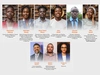
Three Sudanese creatives – Islam Elbeiti, Ahmad Hikmat, and Khalid Albaih – anchored the day’s keynote panel, sharing their experiences and offering clear insights for action.
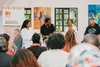
Duaa Mohamed, Islam Elbeiti, Ahmad Hikmat, and Khalid Albaih speak at the Sudan Youth Dialogues, Nairobi Edition, April 29, 2026.
Khalid built a grants fund and art residency out of necessity, not ambition. As a working artist, he found himself drawn into fundraising and institution-building because the need in his community was overwhelming, and no one else was filling the gap. As he put it plainly: if the institutions existed, he would not be running them. He would be making art.
Ahmad spent over a decade building a radio career in Khartoum, cultivating an audience, respect and understanding of the media ecosystem. That knowledge does not transfer neatly across borders. In Nairobi, the audiences are different, the formats are different, the context is different. What he built cannot simply be replicated. Adaptation is not just a practical challenge, it involves real creative and professional loss.
And Islam, a bass player and founder of artist support organizations, spoke to a common thread of the day – the sense of community that sustains Sudanese artists in displacement. Where formal support structures are absent, artists lean on each other and opportunities are shared. As she put it, "Any door that opens to us, we feel responsibility to open another door for other people as well."

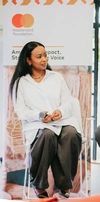
Hannah Tsadik, the Foundation’s Kenya Country Director, distilled what conversation had surfaced: “Creative talent is not the gap. The gap is in enabling conditions.”
As the speakers shared their insights, and the audience asked questions and engaged with one another, one thing became clear: The solutions for some of those enabling conditions were present, right here in the room.
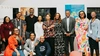
In this unique context, communities that had been working in parallel, often unaware of each other, found alignment. The Sanara Program and Sudanese artist communities are now in conversation. Commitments were made by UNHCR, HEVA Fund, the Life and Peace Institute, Solika Arts, and Inkomoko, including physical spaces for creative pursuits, sector-specific grants, incubation support, pathways to legal documentation, and supporting artists' participation in developing peacebuilding frameworks. HEVA Fund and SNDBX Ubuntu's incubation infrastructure is now visible to artists who need exactly that.
What We Learned
Inspired by our experience in New York, the Foundation arrived to listen and surface opportunities for co-creation. With hundreds of partnerships in Africa, many of which are active in displacement-affected contexts, we are the connective tissue between diverse communities: creative economy investors, displacement programming, youth-led organizations, and civil society. What Nairobi reinforced is that curation is everything. When the right people are brought together with intention and given the space to be honest, action follows almost naturally.
What Comes Next
Concrete commitments emerged – from business registration support to space access to peacebuilding partnerships – and follow-up is underway. Staying engaged means more than convening. It means continuing to listen, following up on what was committed in that room, and being present to the connections that are already possible within the work we are doing.
The question we are sitting with is how to sustain and deepen what was started, and what it would take to bring this conversation to the next city, the next community, the next room full of people who haven't yet found each other.
The Sudan Youth Dialogues, Nairobi Edition was convened by the Mastercard Foundation on April 29, 2026, in Nairobi, Kenya.
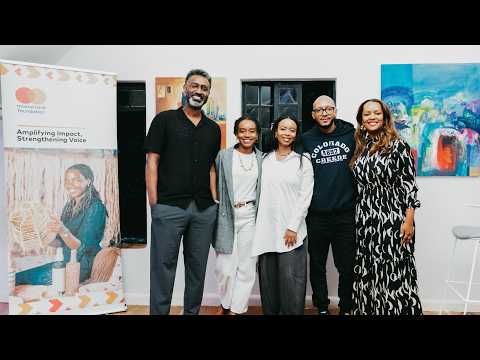
Sudan Youth Dialogues: Nairobi Edition
On 29 April 2026, the Mastercard Foundation convened the Sudan Youth Dialogues – Nairobi Edition, bringing together displaced Sudanese artists, cultural leaders, and ecosystem partners to explore how creativity can drive sustainable livelihoods in contexts of displacement.
World Refugee Day
This World Refugee Day, we celebrate the contributions and talent of refugees and displaced youth across the continent.